

Most riders encounter a Traffic Regulation Order as a sign at a gate, a lane that used to be open and now isn't. Very few see the process that got it there, or understand what it would actually take to challenge one. It's worth walking through both properly, because the process is more mechanical, and more open to challenge, than it often looks from the outside.
What a TRO actually is
A Traffic Regulation Order is a legal instrument a local highway authority uses to restrict or prohibit certain types of traffic on a specific route. On a green lane, that usually means banning motor vehicles while leaving the route open to walkers, cyclists and horse riders. It's a targeted, and in most cases temporary or conditional, tool. That's an important distinction from a permanent extinguishment, which is a separate legal process that removes a right of way from the definitive map altogether rather than just restricting who can currently use it. A TRO restricts use of a right that still exists. Extinguishment removes the right itself.
Who applies for one
The local highway authority, usually the county council or unitary authority responsible for the road network in that area, is the body that makes a TRO. They don't need a court to grant permission first. They act under their own statutory powers, most commonly under the Road Traffic Regulation Act 1984, following an internal decision that a restriction is justified.
That decision doesn't come from nowhere. It's typically triggered by one or more of a fairly consistent set of inputs.
What evidence is typically used
Councils don't need overwhelming proof to justify a TRO, just a reasonable case that one of the following applies:
- Survey data documenting the physical condition of the lane, usually photographs and site visit notes showing rutting, erosion, or damage to the surface and verges.
- Safety concerns, which can range from genuine near-miss reports to general assertions that the lane is unsafe for shared use.
- Environmental damage, particularly where a lane crosses land with any protective designation, or where damage is affecting drainage, hedgerows or adjoining habitat.
- Complaints from residents, walkers, cyclists, or parish councils, which carry more practical weight than most riders expect, especially when they arrive in volume or from an organised group.
In practice, a council rarely needs all four. A run of complaints paired with a site visit showing visible rutting is often enough to start the formal process.
The statutory consultation period
Once a council decides to proceed, it must publish a proposed order, known as the draft or provisional TRO, and give notice of it, typically through local newspapers, notices on site at the lane itself, and its own public register. This opens a statutory consultation period, usually 21 days, though it can vary, during which anyone can lodge a formal objection.
This is the single most important window in the entire process. Objections lodged here become part of the public record and must be considered by the council before it makes a final decision. Organisations like the Trail Riders Fellowship regularly lodge formal, evidenced objections during this window, and an organised, well-argued objection carries far more weight than a string of individual comments saying a lane should stay open.
The council's decision, and what happens after
After the consultation period closes, the council considers the objections received and makes its decision, either confirming the order as drafted, amending it, or dropping it. There's no independent adjudicator at this stage, it's the same authority that proposed the order deciding whether to confirm it, which is one of the more frustrating aspects of the process for objectors.
Once confirmed, a TRO can still be legally challenged, though the routes for doing so are narrow. The main option is judicial review, a High Court process that examines whether the council followed the correct legal procedure, not whether the underlying decision was the right one. Judicial review succeeds on procedural grounds, for example if the statutory notice wasn't properly given, if relevant objections weren't properly considered, or if the council acted outside its powers, not because a judge disagrees with the council's judgement call on safety or damage.
What it realistically takes to succeed
Successful challenges to a TRO tend to share a similar shape, and it's worth being honest about the pattern rather than promising more than the process allows.
Strong evidence of historic use is one route in, particularly where a claimant can show the lane has a longstanding, well-documented history of vehicular use that supports its status, which matters both for objections during consultation and for any separate application to record an unrecorded right before it's lost. Procedural failures by the council are another, and a genuinely common one, missed notice periods, inadequate consultation, or a TRO based on evidence that doesn't hold up to scrutiny can all form the basis of a valid objection or, in serious cases, a judicial review claim. Organised, evidenced objection through bodies like the TRF tends to succeed more often than individual complaints, simply because it arrives with the documentation and legal grounding a council has to take seriously.
In a case like this, a lane facing a TRO on erosion grounds might see the order narrowed rather than dropped entirely, restricted to certain months or weather conditions instead of a blanket year-round ban, where objectors can show the damage is seasonal and the underlying right of way itself isn't in question. That's illustrative of the general pattern, not a specific event, and every case turns on its own facts, its own council, and its own evidence.
The realistic odds
Challenging a TRO after it's confirmed is difficult, and it's worth being straightforward about that rather than suggesting otherwise. Objecting during the consultation period, before confirmation, is a far stronger position, because that's the point where the council is still required to weigh the objection rather than defend a decision it's already made. The earlier riders and organisations engage, the better the realistic odds of a fair outcome.
"By the time a TRO notice is up at the gate, most of the useful window has already passed. The consultation period is where lanes actually get saved, not the appeal afterwards."
— Mat Stuckey, founder of Holloway
This is also why staying ahead of the wider access picture matters, not just individual TROs. See the access crisis nobody is talking about loudly enough for how TROs sit alongside Section 53 deadlines and enforcement trends. And for the basics on what a TRO is before you're dealing with one, see what is a Traffic Regulation Order and how could one ruin your ride.
This is general reference information on how the process works, not legal advice on any specific lane. Legal status can change, and the only reliable check before riding is current signage and the council's own TRO register.
Know before you go
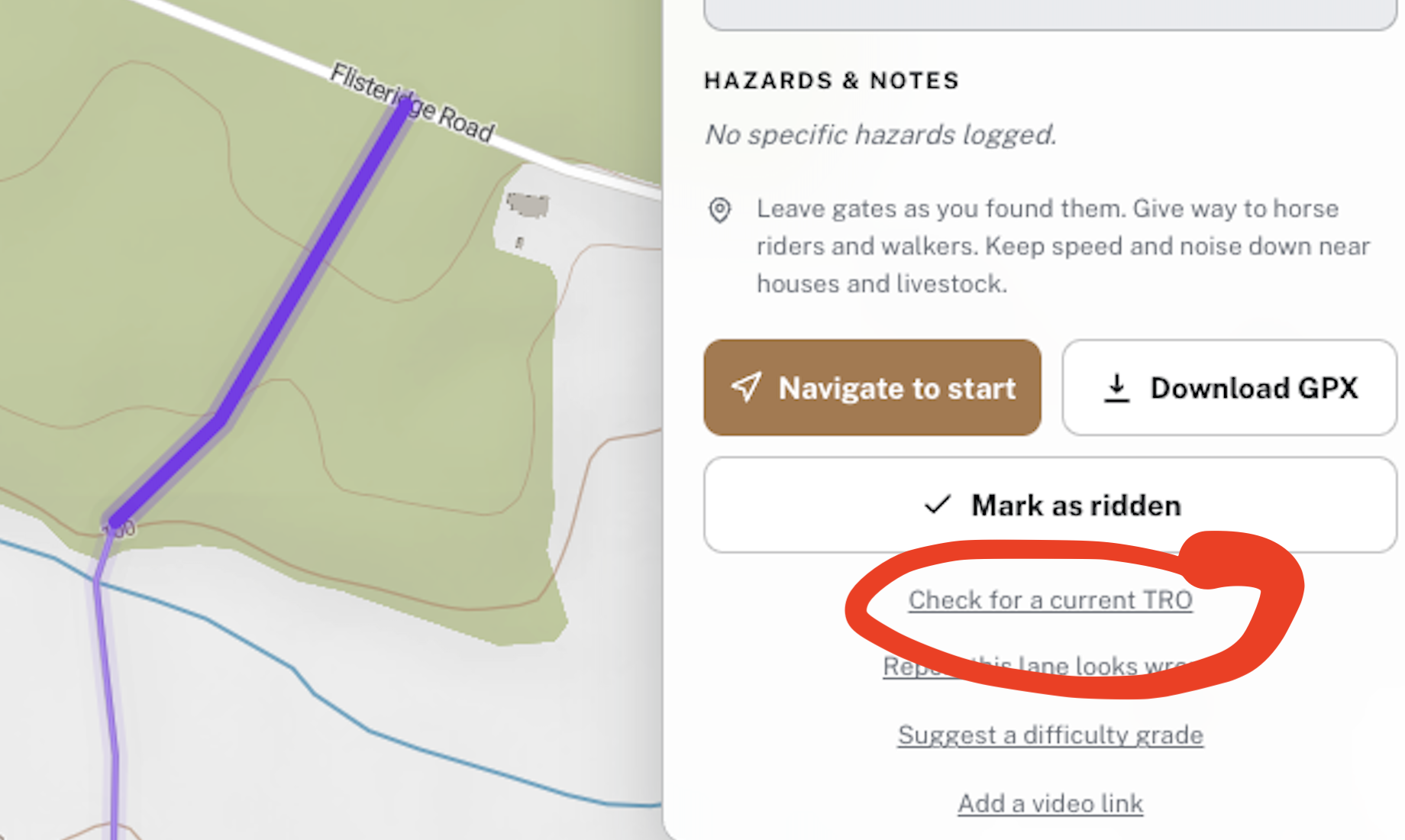
Holloway is free to use: every legal green lane across England and Wales, its legal type, difficulty, hazards and helps search for current TRO or closure status, so you're not relying on outdated word of mouth. Click the Check for TRO label on any lane and the app will take you to a Google search for that lane by name, so you can find the status yourself quickly. For £20 a year, Holloway Premium adds full route planning, road-following connectors between lanes, GPX export, exact coordinates and live weather, giving you everything needed to plan a full day out on lanes you know are actually open.