


You've checked the Definitive Map. The lane is a BOAT. It's legal, in principle, for a motorcycle. And yet you can still turn up and find it closed, because none of that accounts for a Traffic Regulation Order, and a TRO can override everything else you thought you knew about a route.
What a TRO actually is
A Traffic Regulation Order is a legal instrument made by a local authority, under powers granted mainly by the Road Traffic Regulation Act 1984, to restrict or ban certain types of traffic on a specific route. On green lanes, a TRO is most commonly used to prohibit motor vehicles, cars and motorcycles included, while still allowing walkers, cyclists, and horse riders to use the same route.
A TRO doesn't change a route's underlying legal classification. A BOAT that's had a TRO placed on it is still, on paper, a Byway Open to All Traffic. What the TRO does is layer a restriction on top, and for practical purposes, on the day you turn up, that restriction is what counts.
Permanent versus temporary TROs
Not all TROs work the same way, and the distinction matters for how you plan around them.
A permanent TRO closes a route to motor vehicles indefinitely. These typically follow a period of consultation and are usually a response to sustained damage, erosion, or ongoing conflict between users, and once in place they tend to stay in place. A route under a permanent TRO should be treated as off limits, not as a grey area worth chancing.
A temporary TRO is time-limited, and can be put in place for reasons including seasonal ground conditions, active conservation work, or short-term issues such as storm damage or a landslip. Some councils apply seasonal TROs as a matter of routine on certain lanes, closing them over the wetter months and reopening once ground conditions recover. A lane can be entirely legal to ride in July and closed by the same council in November, with no change to its underlying classification at all.
Why councils reach for a TRO
Councils don't impose TROs for the sake of it. The most common triggers are damage to the surface, often from vehicle use in wet conditions on ground that can't take it, complaints from other users or nearby residents, and conservation concerns where a route crosses sensitive habitat. A rutted clay track that's fine in August can turn into a genuinely damaging quagmire by November, and repeated use in that state is one of the fastest routes to a permanent closure.
This is one of the reasons responsible riding matters beyond simple courtesy. Every TRO placed on a green lane reduces the network available to everyone, and avoidable damage gives councils an easy justification for closing routes for good.
How to find out if a TRO is in place before you ride
TRO information is one of the messier corners of UK green laning, because there's no single national register. Sources worth checking include:
- The relevant county council's website, though the format, completeness, and how recently it's updated vary a great deal between authorities.
- The Trail Riders Fellowship (TRF), which tracks TROs affecting the green lane network and campaigns on behalf of riders where closures are contested.
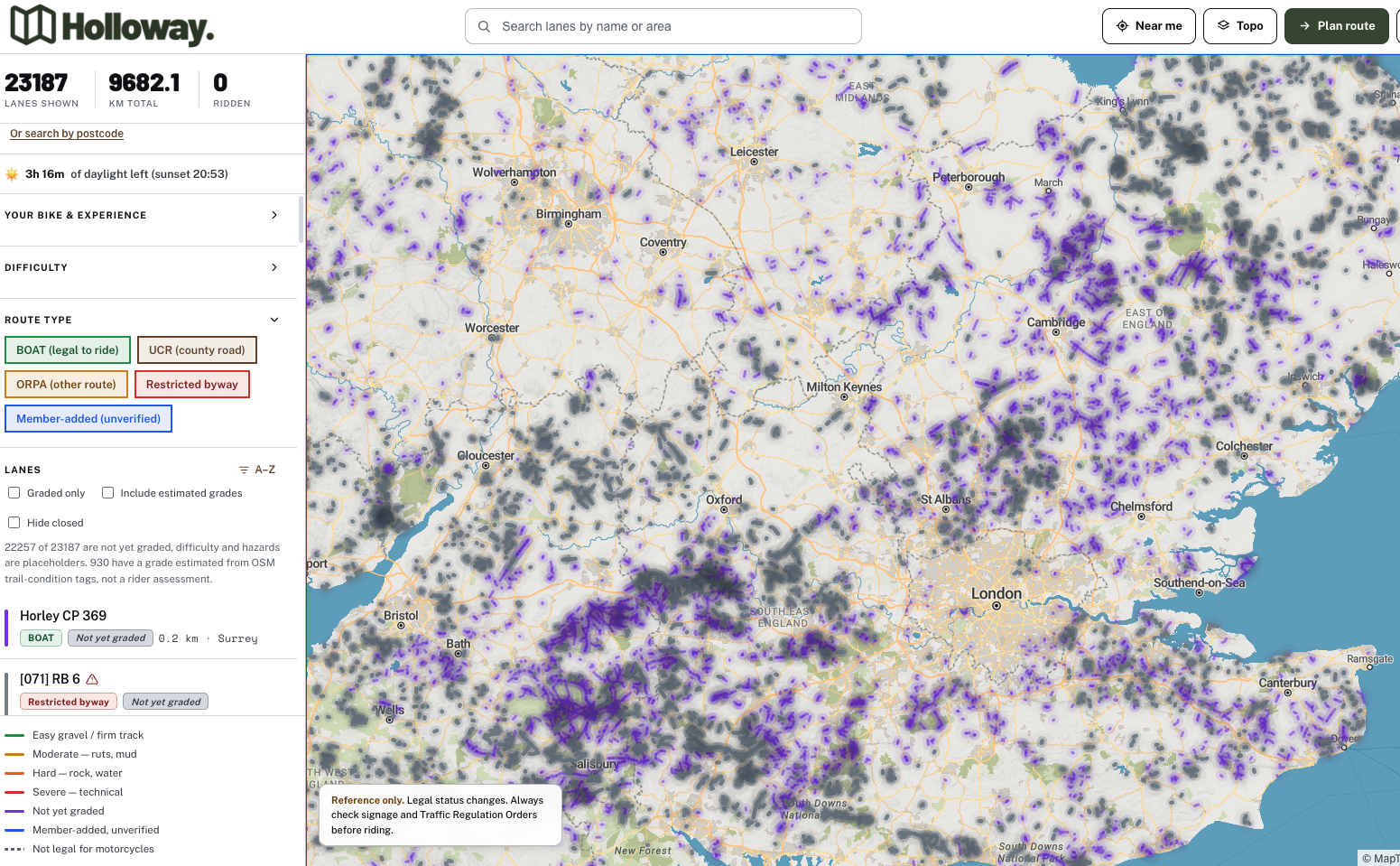
- Holloway, where current closure and TRO status is shown alongside each lane's classification, difficulty, and hazards, so you're not cross-referencing several different sources before a ride.
You can check whether a TRO applies to a lane on Holloway's map before you set off, which is a good deal quicker than working through individual council pages one at a time. For more on the TRF's role in tracking and contesting these closures, our piece on what the Trail Riders Fellowship does and whether you should join covers it in detail.
Whatever source you use, treat it as a starting point rather than a final answer. Signage on the ground, where it exists, takes precedence, and it's worth building the habit of checking it even after you've done your homework online.
"The frustrating TROs are the ones nobody could have seen coming from a map alone. A closed sign at the entrance to a lane you'd planned your whole day around is a bad way to find out."
— Mat Stuckey, founder of Holloway
What happens if you ignore one
Riding a route in breach of a TRO is a road traffic offence. It can result in a fine, and depending on the circumstances, points on your licence. Beyond the legal consequence, riding past a TRO does real damage to how green laning is viewed by councils, landowners, and other route users, and makes future closures more likely rather than less. A TRO you disagree with is worth challenging through the proper channels, the TRF being the main body for that, not simply ignoring.
Check twice, ride once
A route's legal classification and its current TRO status are two separate questions, and you need answers to both before you ride. This article is reference information rather than a live status feed, so always check current signage and the latest TRO listings on the day, whichever source you've used to plan.
Holloway is free to browse: every legal green lane in England and Wales, its classification, difficulty, hazards, and you can even check whether it's currently open by clicking through to the appropriate Google search for every single lane in our system.
 For £20 a year, Holloway Premium adds full route planning with road-following connectors between lanes, GPX export, exact coordinates, and live weather, so you can build a full day out with confidence in what's actually rideable.