


Most guides to green laning start with a kit list. That's the wrong place to start. Before you think about tyres, tools or a tank bag, there are four things worth sorting out, and none of them cost much.
Know the law before you know the route
Green laning sits on real legal ground, and it pays to understand it before your first ride rather than after a conversation with a landowner or a police officer. Not every track that looks like a lane is open to motor vehicles. A BOAT (Byway Open to All Traffic) is legal to ride. A restricted byway, bridleway or footpath is not, no matter how wide, dry or well used it looks from the gate.
Unclassified County Roads, or UCRs, add a wrinkle worth knowing early. Being on a council's list of UCRs doesn't automatically confirm the same statutory right to drive that a BOAT carries. Some UCRs are fine. Some aren't. Treat that distinction as something to check every time, not something to assume. For the full breakdown of what each classification means and where the grey areas sit, our legal explainer is worth ten minutes before you ride anywhere.
Legal status also isn't fixed. A lane open last year can carry a Traffic Regulation Order this year, closing it seasonally or permanently. Always check current signage on the ground and the current TRO list, not last summer's memory of the lane.
Choose a bike that suits the job, not the image
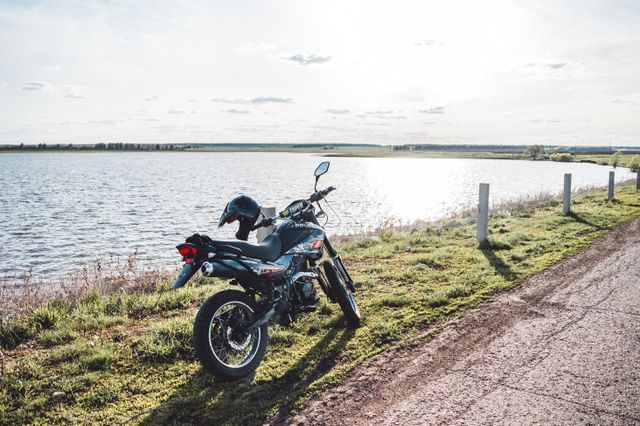
You don't need a big adventure bike to start. In fact, a smaller, lighter machine is usually the better first choice. It's easier to pick up on your own when you drop it, which you will, and it gives you more confidence on the technical sections where weight and height work against you.
Ground clearance, wheel size and tyre choice matter more than headline power figures. A well set up trail bike or an older enduro machine will get you round most beginner-friendly lanes without drama. We cover this properly in choosing your first green laning bike, but the short version is this: start with what suits the terrain, not what looks the part in a car park.
Learn to read a route before you commit to it
A green lane on an OS map is a set of lines and symbols. Learning to read what those lines mean, gradient, surface hints, where a lane crosses water, saves you from committing to something well beyond your ability on the day. Satellite imagery adds another layer, showing you standing water, overgrowth or recent damage that a paper map can't.
This is a skill worth building from ride one, not something to defer until you're "more experienced". Reading a lane properly before you set off is what keeps a day enjoyable rather than a slog. We go into this in detail in how to read a green lane before you commit to it.
Tell someone where you're going
This is the least glamorous item on the list and the most important. Green lanes are often remote, phone signal is patchy at best, and a simple mechanical failure or a minor off can turn into a long, cold wait if nobody knows where to look for you.
Tell someone your planned route, your expected return time, and what to do if you're significantly late. It takes thirty seconds and costs nothing.
What can wait
You don't need the full recovery kit, tubeless conversion or a GPS unit on day one. You don't need to have ridden every lane within fifty miles before you feel "ready". Kit, tyre choice and route planning tools all matter, but they matter more once you've actually got a few easy rides under your belt and know what you're dealing with.
"People overthink the gear and underthink the map. Sort the legal status and the route first, the rest follows."
— Mat Stuckey, founder of Holloway
Your first practical step
Find one easy, verified BOAT near you. Not the longest one, not the most scenic one, just a short, low-difficulty lane with a confirmed legal status and no reported closures. Ride it, turn around, and ride it again if you want. That's a genuinely useful first outing, far more useful than a long day on unfamiliar ground with an unclear legal picture.
You can check current legal status, difficulty and hazards on Holloway's map before you go, all free to browse with no account needed.
Start simple, build from there
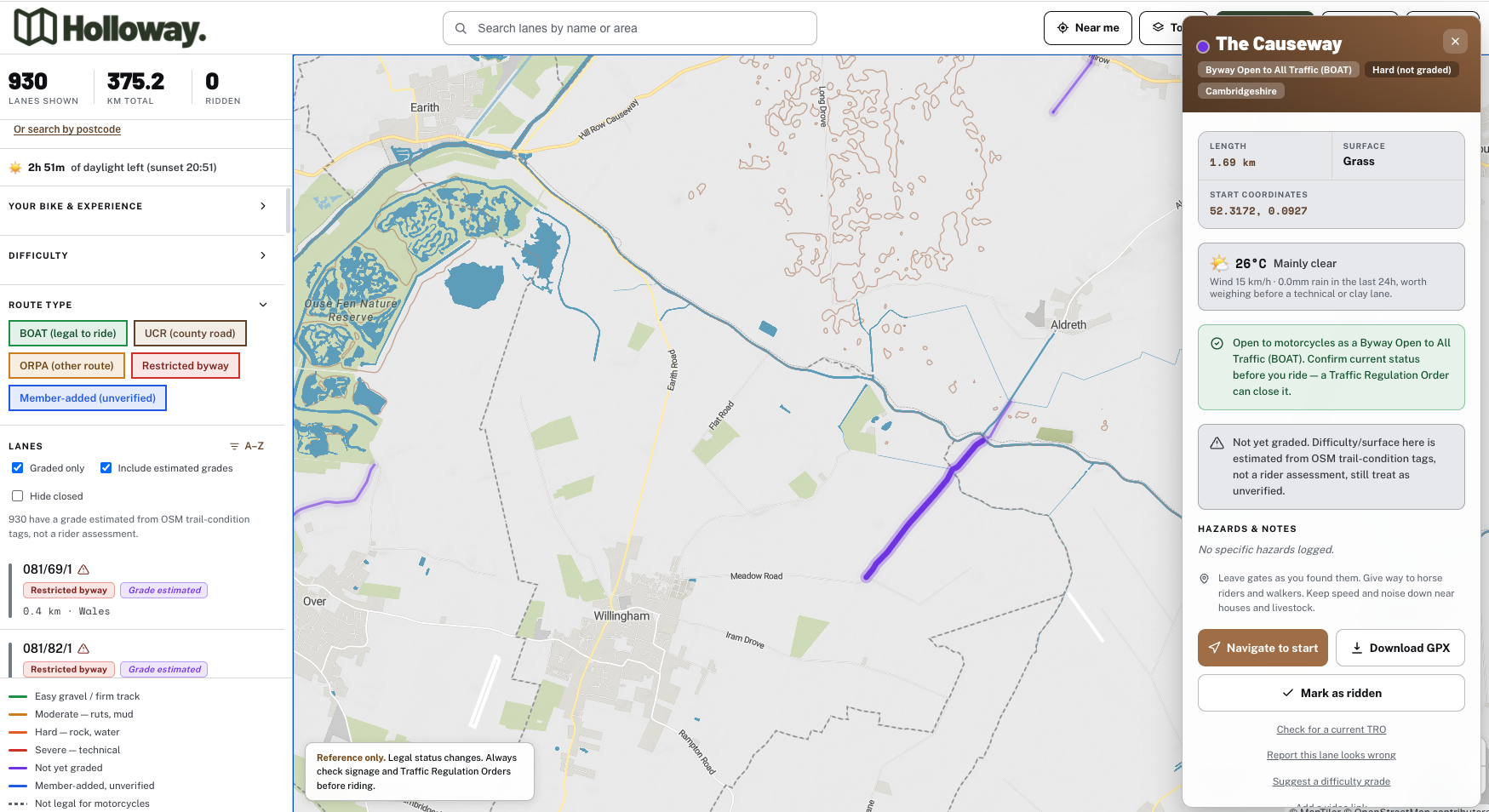
Holloway is a modern, simple tool to find legal green lanes, byways and more across England and Wales, showing every lane's classification, difficulty, length, hazards and whether it's currently open, free, with no account required. When you're ready to plan proper routes, Holloway Premium, at £20 a year, adds full route planning with road-following connectors between lanes, GPX export, exact coordinates, live weather and navigate-to-start, everything you need to build a full day out and take it with you.