
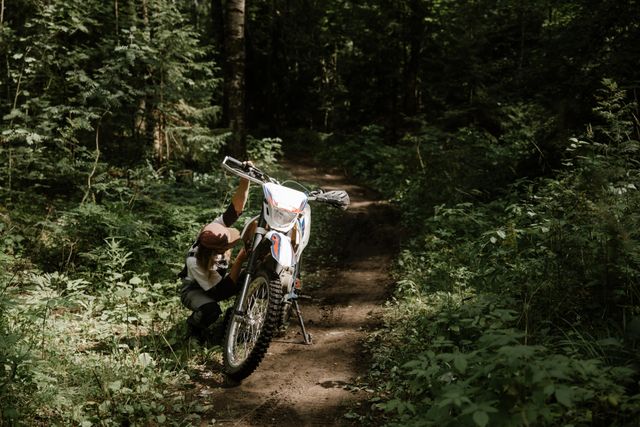
Every rider who spends time on green lanes gets stuck eventually. It isn't a sign of poor riding, it's a sign you've been riding lanes that actually test you. What separates a five-minute inconvenience from a genuinely bad afternoon is what happens in the first sixty seconds after the bike stops moving.
Stop. Think. Then act.
The instinct when a bike bogs down is to keep the throttle open and try to power through it. That instinct is usually wrong. More throttle on a spinning rear wheel in mud or sand digs the wheel deeper and throws you further off balance, turning a bike that's stuck into a bike that's stuck and buried.
The moment you feel the bike losing momentum and sinking, come off the throttle, get a foot down, and stop. Take a breath before you do anything else. Look at what's actually holding the bike, which wheel, how deep, what the ground looks like around it, before you decide what to try. Most of the damage done in stuck situations happens in the panic before anyone's actually looked at the problem.
Why the first sixty seconds make it worse
People make a stuck situation worse in three ways almost every time. They keep the throttle open after the wheel starts spinning, which digs the hole deeper. They try to muscle the bike upright or forward with brute strength before assessing the ground, which wastes energy and often shifts the bike into a worse position. Or they get frustrated and rock the bike aggressively without a plan, which can bury a wheel further or drop the bike entirely.
A slower, more deliberate first response almost always beats a fast, forceful one. Get off the bike, kill the engine if it's still labouring against something, and actually look before you touch anything.
Solo recovery by surface type
Mud is about weight distribution and traction, not force. Clear mud away from the wheel that's stuck, particularly from in front of and around the tyre, since packed mud against a wheel adds resistance you don't need. If you're carrying anything flat and rigid, a section of matting, deadwood, even a jacket in an emergency, wedge it under the rear wheel for grip and walk the bike out under light, steady throttle while pushing from behind rather than trying to ride it out sitting down.
Sand recovery relies on momentum more than brute force. If you've bogged down in sand, try to reverse out along your own tracks first, since that ground is already compacted by your tyre on the way in. If reversing isn't possible, lighten the front by leaning back, keep the wheel straight, and use smooth, sustained throttle rather than bursts, walking alongside if needed rather than trying to power out from a seated position.
A ditch or rut is more about lifting than throttle. Assess which way the bike needs to move to get a wheel back onto solid ground, then lift or walk it in that direction rather than trying to ride it out of an edge that's steeper than it looks. Trying to power a bike up and over a rut edge from a standing start is one of the more common ways a stuck situation becomes a dropped bike.
When to accept you need help
There's no shame in needing a hand, and recognising it early is usually the difference between a minor delay and a genuinely bad day. If you've made two or three considered attempts and the bike hasn't moved, or if you're alone, tired, and the light's starting to go, that's the point to stop trying and start asking. Continuing to try alone, exhausted, past that point is how a stuck bike becomes an injured rider.
Riding with others is the simplest safeguard here. A second person to help lift, push, or fetch something from further down the lane turns almost any stuck situation from a problem into a five-minute job. If you're riding solo, tell someone your planned route and rough timing before you set off, and carry a means of calling for help in areas with patchy signal.
"Nearly every bad stuck situation I've seen started the same way, someone kept the throttle open after the wheel had already stopped gripping. Stopping early and looking properly costs you thirty seconds. Not stopping can cost you the rest of the day."
— Mat Stuckey, founder of Holloway
What to carry specifically for recovery
A short list, but worth having on every ride rather than just the ones you expect to be difficult.
- A folding shovel or entrenching tool, for clearing mud or digging out a wheel.
- A tow strap or length of rated rope, for a second bike or vehicle to assist.
- A basic tyre pressure gauge and a way to reinflate, since dropping pressure helps in sand but needs putting back before the road.
- Gloves suited to handling a hot exhaust or a filthy wheel, kept separate from your riding gloves.
- A means of calling for help that doesn't rely on mobile signal alone in remote areas.
Avoiding the situations that cause most recoveries
The best recovery is the one you never need. Most stuck situations trace back to the same handful of causes: riding a surface in conditions it wasn't suited to, committing to a lane without reading it properly first, or riding beyond what the bike's loaded weight and the rider's experience could reasonably handle that day.
Checking a lane's current surface condition and grade before you commit to it removes a good chunk of the risk before you've even set off. So does a sensible read of the lane itself once you're there, rather than trusting a grade or a memory of how it rode last time.
It's also worth learning to read a lane before committing to it, and understanding how surface type changes what a lane demands of you, since clay in winter and sand in summer both cause a disproportionate share of the recoveries riders deal with each year.
Check before you ride
None of this changes what's legal to ride in the first place. Getting a bike unstuck from a restricted byway, bridleway or footpath doesn't make riding it legal, and a UCR being on a council's road list is worth double-checking too, since it doesn't automatically carry the same statutory right as a BOAT. Always confirm a lane's legal status and current condition before you commit to it.
Holloway's free tier gives you every legal lane's name, legal type, difficulty, length, hazards and current closure or TRO status, at no cost and with no account needed, so you can judge what a lane's likely to ask of you before you're in it. For £20 a year, Holloway Premium adds surface type, exact coordinates, live weather and full route planning with GPX export, so you can build a day around lanes that suit your bike and experience rather than finding out the hard way. Check a lane's data and more on Holloway's map before you set off.