

Ask ten riders to grade the same lane and you'll get ten different answers. Not because they can't agree on what they saw, but because the lane isn't a fixed thing. It changes with the bike underneath you, the weather that week, and which end you started from. A single difficulty number papers over all of that, and papering over it is how people end up somewhere they shouldn't be.
Easy on a 250 isn't easy on a loaded 1200
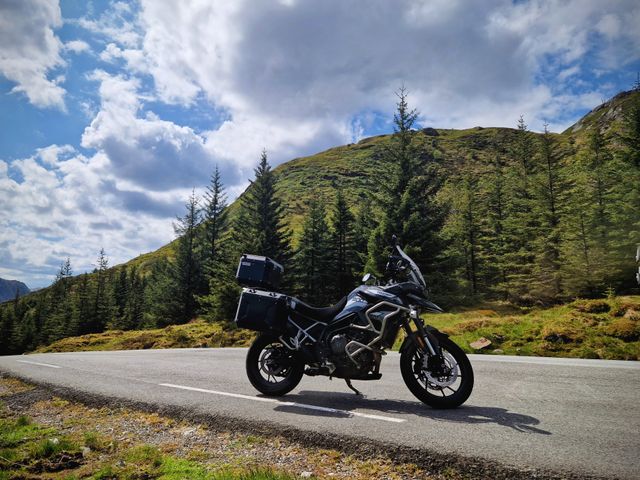
A tight, off-camber lane with a couple of awkward roots is a non-event on a light enduro bike. Stand up, weight the pegs, let the bike move underneath you. Put the same lane under a fully loaded adventure bike with panniers, a top box and a tank full of fuel, and the maths changes completely. The centre of gravity is higher, the turning circle is worse, and a mistake costs more because there's more weight to catch.
This is the first problem with any single grade. "Easy" has to mean something, and it can't mean easy for everyone on everything. A grade that doesn't say which kind of bike it assumes is a grade that's quietly misleading half its readers.
Direction changes the lane
The same lane ridden in opposite directions can be two different experiences. A climb one way is a descent the other, and descents ask different things of a rider, particularly on loose surfaces where engine braking and front brake control matter more than throttle control. A tight, blind bend that opens up gently from one direction might arrive with no warning from the other.
Camber works the same way. A lane that sheds water neatly when you're climbing can pool and hold it when you're heading down, simply because of how the ruts have formed. If a grade doesn't account for direction, it's really only describing half the lane.
Wet chalk isn't dry chalk. Winter clay isn't summer clay.
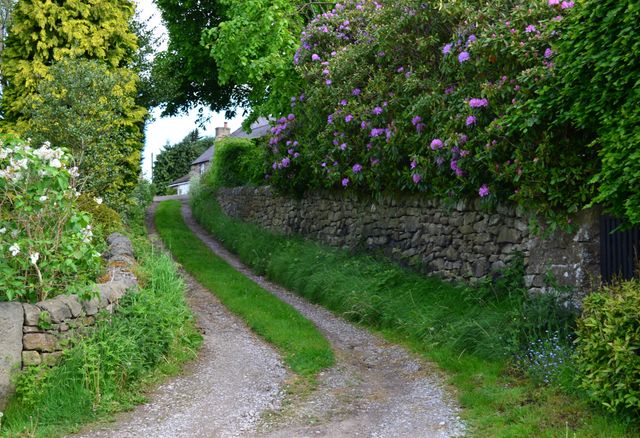
Surface type does more to change a lane's character than almost anything else, and surface type isn't fixed either. Chalk that's fast and grippy in a dry August can turn into something closer to wet ice after a night of rain, because the top layer greases over while the base stays hard underneath. Clay is worse. A clay lane that's firm and forgiving in summer can become genuinely unridable by December, rutted to the axle and holding water in every low point.
Sand sits somewhere else again. It doesn't really get more or less difficult with the weather, it gets more or less difficult with how much of it there is and how consistent it is, which depends more on recent traffic and wind than on rainfall.
None of this means grading is pointless. It means a grade needs to say what conditions it assumes, and a rider needs to adjust it based on what the last few weeks of weather have actually been like, not what the map said in isolation.
How Holloway grades, and why
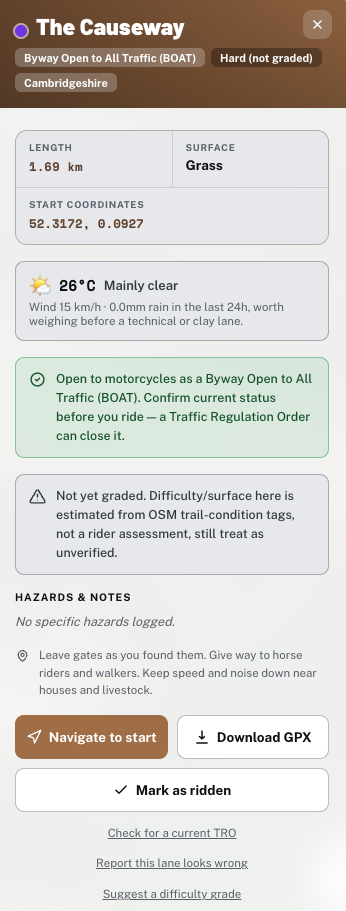
Holloway's difficulty rating is built to be a starting point, not a verdict. It tells you the baseline character of a lane under reasonable conditions, on a bike suited to that terrain, so you have something honest to compare against rather than a single word doing all the work. But the real beauty will be over time as the community suggests grades. Alongside the grade you get the lane's legal type, its length, and any known hazards flagged by other members, because those are the things that actually change whether a lane is sensible for you on a given day.
What Holloway can't do, and doesn't pretend to do, is tell you what the lane looks like at 8am this morning after three days of rain. No app can. That's still down to judgement, local knowledge, and reading the lane in front of you before you commit to it. But as time goes by and our community continues to grow, the data we'll accumulate will give you the best idea of how a lane is before heading there.
"A grade is only useful if you know what it's not telling you. We'd rather give riders an honest baseline and let them apply their own judgement on the day, than hand out a false sense of certainty."
— Mat Stuckey, founder of Holloway
What makes a grade useful, not just a number
A useful grade tells you enough to make a real decision. That means naming the surface, being honest about seasonal variation, and flagging where direction matters. A useless grade is a single word with no context, applied the same in January as in July, on a 125 as on a fully loaded twin.
Before you rely on any grade, whether it's Holloway's or a paper guidebook's, it's worth learning to read a lane before you committing to it, so the grade is a second opinion rather than the only one.
None of this replaces checking legal status either. A lane's difficulty is irrelevant if it's a bridleway or footpath, where riding a motor vehicle isn't legal regardless of how wide or well used the track looks. Always check current status before you ride.
Holloway's free to browse, and paid adds the planning
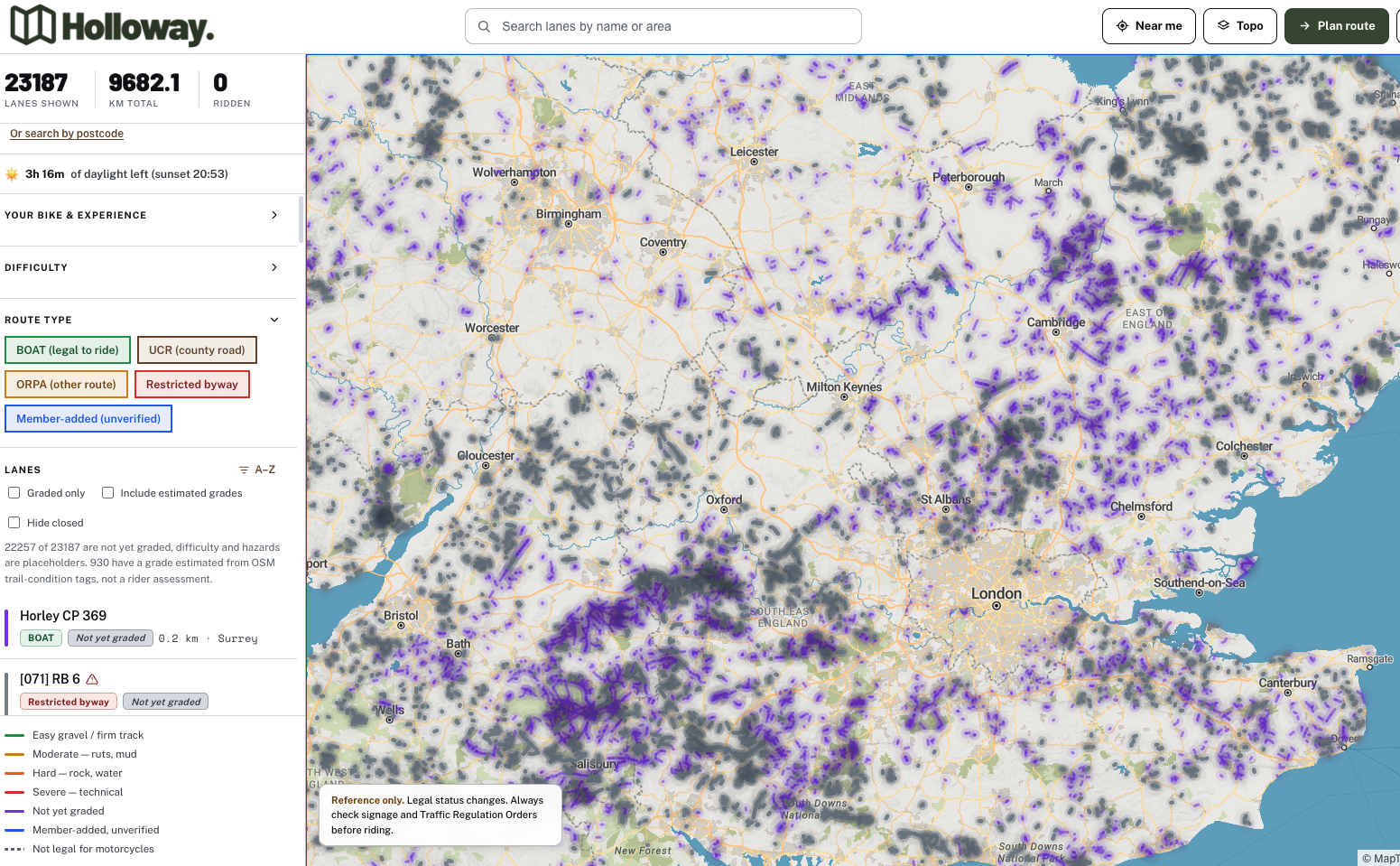
Holloway's free tier gives you the map, search and filters, a bike and experience preset, and every lane's name, legal type, difficulty, length, hazards and can help search for current closure or TRO status, all at no cost and with no account needed. For £20 a year, Holloway Premium adds surface type detail, exact coordinates, live weather, full route planning with real road-following connectors between lanes, GPX export, and navigate-to-start, everything you need to turn a single graded lane into a proper, multi lane day out. Check current legal status and grading on Holloway's map before your next ride.